Dorian Builds His Powered Army
The Night CleanerDorian Builds His Powered Army is the turning point at which Dorian’s long-standing grievance becomes an organized military project. He combines blood-based power transfer with a vision of liberation that also serves his revenge: the gifted, in his view, should no longer hide their abilities, and his new force will give him the means to challenge Draco and the Hero Society.
Motive and Design
Dorian’s plan grows from jealousy and anger over Draco being chosen in preference to the gods’ own children. He tried to destroy Draco, then learned that Draco was immortal; even demigods, Dorian understood, would eventually die. He therefore set himself three aims: to become immortal, prevent Draco from completing his mission, and let humanity collapse into its own chaos. He describes the first aim as the easy part. The other two remained obstacles, and his pursuit of revenge gave the project its direction.
The army was not simply a collection of followers. Dorian wanted to reproduce powers that already existed among the Hero Society’s members, giving his own people comparable abilities. He saw these powers as gifts that people should be free to use for their own needs. In his view, Draco’s standards for deciding who was fit to wield power—and the Hero Society’s forgiveness of Draco for killing people he judged unfit—made its moral authority suspect. Dorian’s opposition thus rested on both a personal vendetta and a broader dispute over who could use power, and under whose rules.
Blood, Immortality, and Transfer
Blood is the mechanism joining Dorian’s survival to the army’s creation. He maintains his immortality by infusing gifted people’s blood with his own, a process that takes several hours and leaves him bedridden until it is complete. He watches the infusion machine mix his gold-tinged blood with donated blood from a man powered by a god. The procedure is a recurring requirement, not a permanent escape from physical limits: Dorian later notes that he can grow weary in a fight, even though his energy returns quickly.
The supply of blood also changes the practical scale of his operation. Dorian once took donations from people he encountered on the streets; by the time he describes the process, the hospital has so much donated blood that he no longer needs to obtain it himself. Donors give without thinking about their powers, allowing him to draw on a supply whose significance they do not recognize. He presents Draco’s blood as the missing key: when mixed with the blood of people whose DNA carries power genes, it allows those powers to persist in new hosts. That discovery converts blood from a means of extending Dorian’s life into the basis for building a force.
The Army and Its Training
Dorian calls the result his own version of the Hero Society, while stressing that its members are not clones. They are new hosts with the same kinds of powers as the people he opposes: strength, empathy, and shapeshifting, alongside a computer specialist and a killer. The only power he says he lacks is magic, which he considers of little use against the power of the gods. This comparison gives the army its purpose: it is designed to meet the Hero Society on familiar ground, but under Dorian’s command.
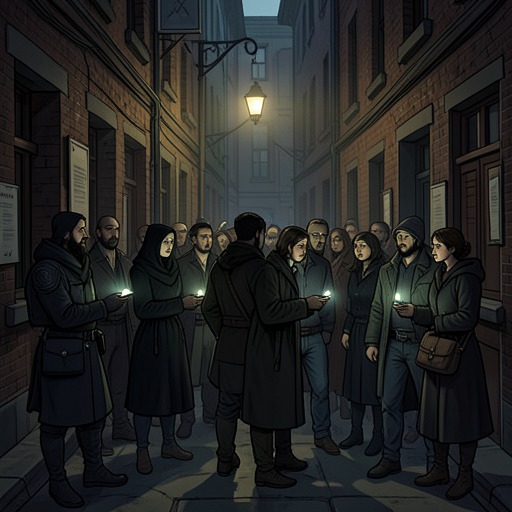
He does not treat the new abilities as ready-made weapons. Dorian instructs his followers to keep practicing until they can control their powers, then moves among them to check their progress. His attention to training suggests that the transfer alone is not enough; the recipients must learn to use what they have gained. He believes the work is proceeding smoothly and thinks that Emanuel’s fall to the heroes has, paradoxically, helped by demonstrating how much time had been wasted. The remaining priority, he concludes, is obtaining blood from Draco.
Ideology and Opposition
Dorian frames his project as a campaign to end concealment and fear. He wants the gifted to live openly and without persecution, arguing that people with power should not be made to belittle what they have been given. His account of the future he rejects is embodied by Phillip: Phillip’s power comes from Apollo, as does a power Dorian shares, but Phillip’s visions are constant, while Dorian can switch his own future-sight on and off. Phillip sees a future in which people like themselves are heroes, protected while they save and defend humans. Dorian knows that imagined ending and chooses a different path.
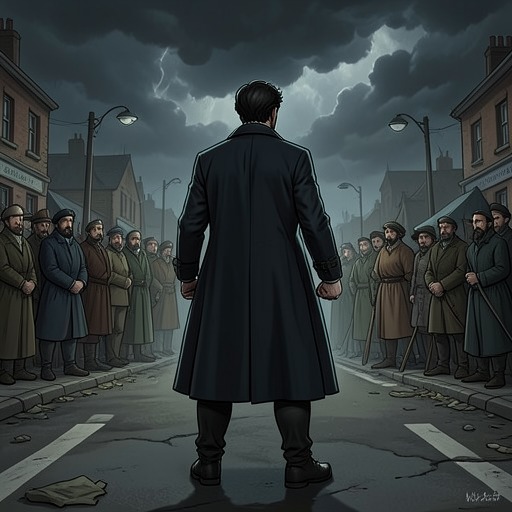
The distinction between their visions is central to the army’s meaning. Dorian speaks of freedom, but his project also depends on using other people’s blood and directing their newly acquired abilities toward his own objectives. His rhetoric of release therefore exists beside a hierarchy of command: he selects the strategic aim, orders practice, and expects the hosts to follow him. When Draco confronts him and demands that he end the harm, Dorian presents their disagreement as two competing visions of how to improve the world. Neither regards the other as a neutral opponent; their conflict is personal as well as political.
Deployment and Consequences
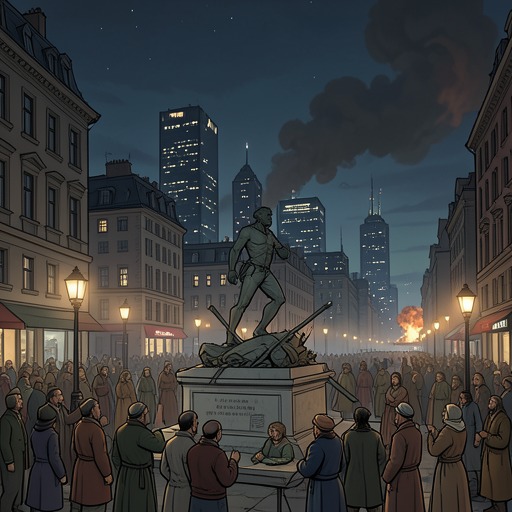
The army’s later actions make clear that its creation was preparation for an actual confrontation. Dorian deploys allies to destroy the bridge connecting the island to the mainland; the bridge is empty when it falls, but its destruction cuts off the route onto the island. A citywide blackout follows, block by block, as the next phase of his plan begins. These actions turn his argument about freedom into a military campaign with consequences for the city and its inhabitants.
Before the fighting, Dorian urges the remaining members of the Hero Society to join him, telling them that their organization is over and that humans who had recently been willing to hurt them had abandoned them. He acknowledges that he expects them to refuse. The city then becomes a battlefield, with opponents matched against one another, while Dorian and Draco meet as the conflict’s central duel. Dorian’s army is thus both the practical instrument of his challenge and the embodiment of his unresolved grievance: it gives him a force capable of confronting Draco, but carries his struggle over freedom into a violent contest for control.